
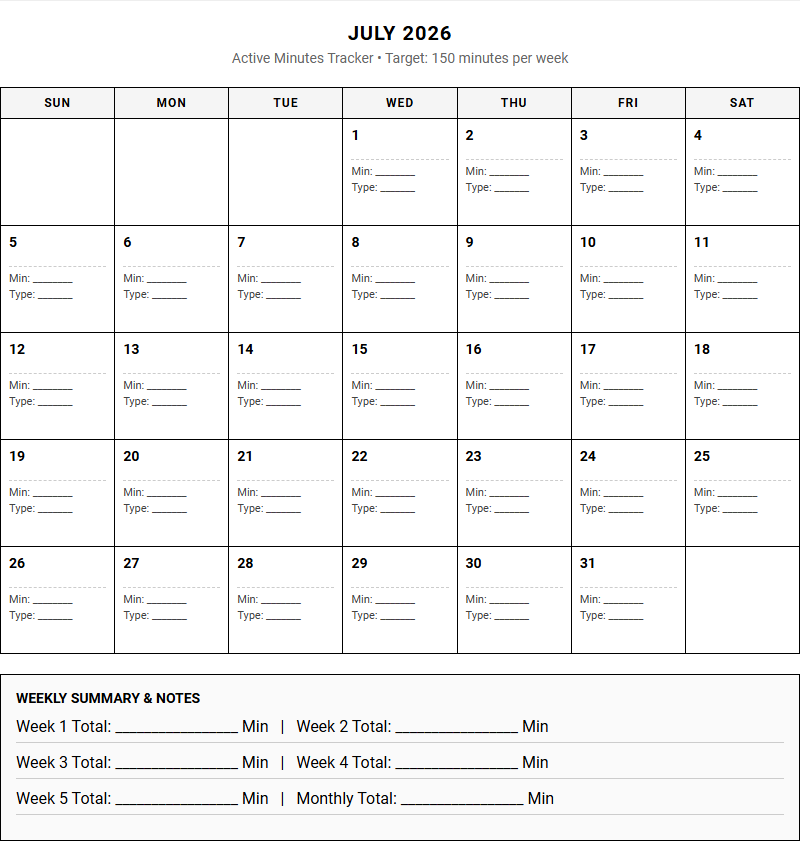
Consistency in physical activity is a common hurdle, with many struggling to accurately log daily exertion. While employer wellness grants and fitness subsidies provide initial funding resources, sustainable habit formation requires personal engagement. This Active Minutes Tracker calendar grants immediate visual accountability, provided users commit to the stipulation of honest, daily recording. Whether tracking a brisk 20-minute walk or intense cardio, this tool anchors your routine. Below, we examine the optimal strategies to maximize this printable resource.
Create Your Active Minutes Tracker
Done customizing?
Active Minutes Tracker - Good to Know
Active Zone Minutes
Active Zone Minutes (AZM) represent a personalized, highly accurate metric that tracks the time you spend engaging in heart-pumping activities. Unlike standard step counters, AZM monitors the actual physiological strain on your cardiovascular system. By analyzing your unique resting heart rate and age, fitness trackers calculate personalized target zones. You earn active minutes for different levels of exertion:
- Fat Burn Zone: Earns one active zone minute for every literal minute spent here.
- Cardio and Peak Zones: Earns double active zone minutes (two points per minute) due to the intense effort.
This gamified tracking system encourages individuals to push their limits and focus on training quality rather than mere step volume. Maintaining a steady accumulation of these minutes throughout the week ensures your heart receives the stimulus required to improve aerobic capacity, lower resting heart rate, and optimize metabolic efficiency over time.
Intensity Minutes
Intensity Minutes measure the duration of moderate-to-vigorous physical activity accumulated over a weekly cycle. This metric directly aligns with global health guidelines, such as those published by the World Health Organization, which recommend at least 150 minutes of moderate-intensity or 75 minutes of vigorous-intensity exercise per week. To help users meet these benchmarks, smart wearables utilize a dual-threshold calculation:
- Moderate Activity: Occurs when you can still hold a conversation but your breathing is accelerated.
- Vigorous Activity: Characterized by rapid breathing and a high heart rate, making spoken sentences difficult.
Tracking these minutes provides a holistic view of your weekly exercise habits. Consistently hitting your target helps mitigate cardiovascular diseases, strengthens bone density, improves cognitive function, and promotes emotional well-being by stimulating natural endorphin release.
MVPA
MVPA, or Moderate-to-Vigorous Physical Activity, is a foundational epidemiological metric used to gauge overall public health and fitness levels. It represents any activity that expends energy at or above three times the energy cost of sitting quietly. This category encompasses a broad spectrum of movements, from brisk walking and gardening to competitive sports and high-intensity interval training. Health researchers emphasize MVPA because of its strong, scientifically proven correlation with longevity:
"Regular accumulation of MVPA is associated with a significantly reduced risk of type 2 diabetes, stroke, and several forms of cancer."
By monitoring your MVPA, you gain an objective understanding of your functional fitness. Rather than focusing solely on structured gym workouts, tracking MVPA encourages a lifestyle filled with dynamic, energetic movement, ensuring that your body remains highly adaptive, resilient, and metabolically active throughout the day.
Heart Rate Zones
Understanding your Heart Rate Zones is key to customizing your cardiovascular training for specific athletic outcomes. These zones are calculated as percentages of your maximum heart rate (HR Max). They divide metabolic exertion into five distinct physiological phases, each serving a unique purpose in athletic conditioning and recovery:
| Zone | Intensity Range | Primary Benefit |
|---|---|---|
| Zone 1 (Warm Up) | 50% – 60% | Active recovery and metabolic preparation. |
| Zone 2 (Easy) | 60% – 70% | Builds aerobic base and fat oxidation. |
| Zone 3 (Aerobic) | 70% – 80% | Improves overall cardiovascular efficiency. |
| Zone 4 (Threshold) | 80% – 90% | Increases anaerobic capacity and speed. |
By targeting specific zones, you can tailor your workouts to burn fat, build endurance, or maximize peak sprint performance safely.
NEAT Tracking
NEAT Tracking (Non-Exercise Activity Thermogenesis) monitors the energy expended during daily activities that are not classified as formal exercise, sleeping, or eating. This includes activities such as pacing while on a phone call, carrying groceries, cleaning the house, or even fidgeting. Although these movements seem minor individually, they collectively represent a massive portion of your daily energy expenditure.
Tracking NEAT highlights the dangers of the "active sedentary" lifestyle, where an individual works out for an hour but remains completely stationary for the remaining fifteen hours of the day. Increasing your NEAT is a sustainable strategy for weight management because it burns calories without putting intense stress on the central nervous system. Modern fitness trackers use built-in accelerometers to recognize this baseline movement, nudging you to keep moving naturally throughout your day.
Activity Rings
Activity Rings have revolutionized visual fitness tracking by transforming abstract biometric data into simple, motivating, and interactive goals. Typically divided into three distinct concentric circles, these rings monitor different aspects of physical movement:
- The Move Ring: Tracks active calories burned through daily motion and structured exercise.
- The Exercise Ring: Records minutes of brisk activity completed at or above a brisk walking pace.
- The Stand Ring: Encourages you to stand and move for at least one minute during 12 different hours.
The visual feedback loop of "closing" these rings taps into behavioral psychology, creating a satisfying sense of daily accomplishment. This persistent encouragement helps establish lifelong habits, reducing sedentary behavior and keeping you active through simple, fun, daily goals.
Sedentary Alerts
Sedentary Alerts serve as proactive health interventions designed to disrupt prolonged periods of physical inactivity. Modern office environments and screen-based entertainment often lock individuals into static sitting positions for hours on end, which slows down metabolism, decreases insulin sensitivity, and compromises posture. To combat this, smartwatches and fitness bands monitor your real-time inactivity and issue gentle haptic vibrations or on-screen reminders when you remain motionless for too long.
These brief, scheduled breaks encourage you to stand up, stretch, or walk a short distance. Scientific research indicates that breaking up sedentary time every 50 to 60 minutes significantly improves vascular function, lowers post-meal blood glucose spikes, and boosts cognitive focus. Utilizing sedentary alerts is a simple yet powerful way to safeguard your long-term cardiovascular health in a modern, sedentary world.
Daily Movement Goal
Establishing a personalized Daily Movement Goal is crucial for cultivating a consistent fitness habit that fits your lifestyle. Rather than adhering to arbitrary standards, a customized movement goal considers your current fitness level, occupation, and personal wellness aspirations. This metric can be quantified using various indicators:
- Cumulative step counts (e.g., 8,000 to 10,000 steps per day).
- Active calorie expenditure targets adjusted for body mass.
- Total hours with documented physical movement.
By striving for a consistent goal, you build a strong foundation of daily physical discipline. This consistent activity stabilizes energy levels, enhances sleep quality, and strengthens the musculoskeletal system. Over time, achieving these daily targets builds physical resilience, proving that small, daily efforts lead to profound improvements in long-term health and vitality.
METs Calculator
A METs, or Metabolic Equivalent of Task, Calculator is a scientific tool used to estimate the energy cost of various physical activities. One MET is defined as the rate of energy expenditure while sitting quietly at rest, which equates to oxygen consumption of approximately 3.5 milliliters of oxygen per kilogram of body weight per minute (ml/kg/min). By assigning MET values to different activities, the calculator can estimate your energy output:
- Light Activity (< 3 METs): Slow walking, typing, or light housework.
- Moderate Activity (3 – 6 METs): Brisk walking, doubles tennis, or bicycling at a moderate pace.
- Vigorous Activity (> 6 METs): Running, swimming laps, or competitive sports.
Utilizing a METs calculator allows you to compare the intensity of different exercises and tailor your workout routines to meet specific daily energy expenditure and conditioning goals.
Cardio Load Balance
Cardio Load Balance is an advanced training metric that measures the relationship between your acute training load and your chronic training load. Acute training load tracks the stress placed on your body over the last seven days, representing your current level of fatigue. Chronic training load monitors your exertion over the past 28 days, indicating your baseline cardiovascular fitness. Managing this balance is essential for steady improvement:
- Under-reaching: Occurs when the acute load drops too far below the chronic load, causing fitness levels to plateau or decline.
- Over-training: Occurs when acute training increases too rapidly, significantly increasing the risk of injury and burnout.
- Optimal Training: Occurs when acute load slightly exceeds chronic load, safely stimulating cardiovascular adaptations.
Monitoring this ratio helps athletes push their boundaries safely, ensuring sustainable, injury-free physical progression.
Leave a comment