
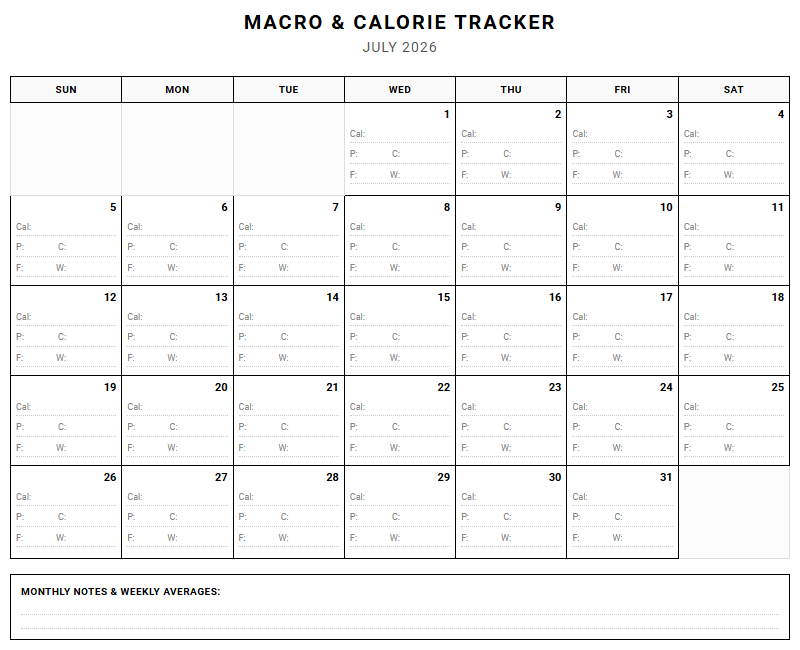
Consistently calculating daily macronutrients can quickly become overwhelming, leading many to abandon their nutritional goals. Typically, fitness enthusiasts rely on expensive app subscriptions or premium coaching to manage these metrics. However, our Macro and Calorie Tracker printable calendar grants immediate visual clarity. While manual tracking requires daily discipline, it fosters deeper dietary awareness. Below, we examine how to utilize this template-specifically for tracking targeted protein metrics-to optimize your nutritional habits.
Create Your Macro and Calorie Tracker
Done customizing?
Macro and Calorie Tracker - Good to Know
TDEE
Total Daily Energy Expenditure (TDEE) is an estimation of how many calories your body burns per day when exercise and daily activity are factored in. Understanding this metric is essential for anyone looking to manage their weight, as it serves as the baseline for determining your dietary needs. Your TDEE is calculated by estimating your Basal Metabolic Rate (BMR) and multiplying it by an activity multiplier that corresponds to your lifestyle.
The daily energy you expend is divided into four primary components:
- Basal Metabolic Rate (BMR): The energy required for basic life-sustaining functions.
- Thermic Effect of Food (TEF): The energy used to digest and process nutrients.
- Exercise Activity Thermogenesis (EAT): The energy burned during structured workouts.
- Non-Exercise Activity Thermogenesis (NEAT): The energy spent during spontaneous daily movements.
By accurately calculating your TDEE, you can tailor your daily caloric intake to align precisely with your fitness goals, whether that involves losing fat, building muscle mass, or maintaining your current physique.
IIFYM
If It Fits Your Macros (IIFYM), also widely known as flexible dieting, is a nutritional philosophy that prioritizes macronutrient targets over specific food restrictions. Instead of categorizing foods as strictly "clean" or "dirty," IIFYM allows you to consume any food source as long as it fits within your daily allotment of proteins, carbohydrates, and fats. This approach offers immense psychological freedom, reducing the feelings of deprivation that often lead to binge eating or diet failure.
To successfully implement this protocol, individuals typically follow these steps:
- Determine daily caloric needs based on physical goals.
- Divide those calories into optimal ratios of protein, carbohydrates, and fats.
- Track daily food consumption using digital food databases or mobile applications.
While this methodology provides unparalleled flexibility, emphasizing nutrient-dense foods is still vital. Consuming micronutrient-rich whole foods ensures optimal biological function, digestive health, and athletic performance while allowing room for occasional processed treats.
Caloric Deficit
A caloric deficit is the fundamental biological requirement for weight loss. It occurs when you consume fewer calories than your body expends over a given period. When this energy gap is created, the body is forced to draw upon stored energy reserves, primarily adipose tissue (fat), to meet its metabolic demands. Without establishing a consistent deficit, fat loss is physically impossible, regardless of the specific dietary protocols or food sources you choose.
To safely establish and sustain a caloric deficit, consider these strategies:
Moderate deficits of 300 to 500 calories below your maintenance level are generally recommended. This moderate approach helps preserve lean muscle mass, prevents severe metabolic adaptation, and keeps hunger hormones manageable. Combining a slight reduction in food intake with increased physical activity is often the most sustainable path to achieving long-term fat loss without compromising hormonal health or overall vitality.
Reverse Dieting
Reverse dieting is a metabolic recovery strategy that involves incrementally increasing your caloric intake over several weeks or months. This technique is primarily utilized after a prolonged period of caloric restriction, such as a fat-loss phase or athletic contest preparation. The goal of a reverse diet is to systematically boost your metabolic rate and normalize thyroid hormone production while minimizing fat gain.
During a long-term diet, the body undergoes adaptive thermogenesis, lowering its energy output to survive on fewer calories. By slowly adding small increments of carbohydrates and fats-typically 50 to 100 calories per week-you can step-by-step restore your metabolism. This process helps transition you back to a sustainable lifestyle, regulating hunger hormones like leptin and ghrelin, and establishing a higher maintenance calorie threshold for the future.
Calorie Cycling
Calorie cycling is a dietary strategy where you alternate between high-calorie and low-calorie days throughout the week. Rather than consuming a static number of calories every day, you manipulate your energy intake to align with your training schedule or psychological needs. This approach is highly effective for maintaining physical performance during a fat-loss phase and preventing severe plateaus.
Common application methods for calorie cycling include:
- Training Day Refeeds: Consuming higher calories, particularly carbohydrates, on intense training days to fuel performance.
- Rest Day Deficits: Reducing calories on sedentary days when energy demands are naturally lower.
- Weekend Flexibility: Allocating higher calorie limits to weekends to accommodate social events and dining out.
This systematic variation helps preserve lean muscle mass, supports thyroid function, and provides a valuable mental break from continuous caloric restriction, making long-term dietary adherence much easier.
Volume Eating
Volume eating is a dietary technique focused on consuming large quantities of food that are low in caloric density. This strategy relies on the principle that physical satiety is heavily influenced by the volume of food in the stomach rather than just the number of calories consumed. By choosing foods with high water and fiber content, you can fill your stomach, trigger stretch receptors, and signal fullness to the brain without overconsuming energy.
Excellent staples for a volume-based diet include:
Leafy greens, cruciferous vegetables, berries, melons, and air-popped popcorn are fantastic choices. Incorporating these foods allows you to enjoy large, visually satisfying meals that take longer to chew and digest. Consequently, volume eating is an exceptionally powerful tool for combating hunger during a fat-loss phase, helping you maintain a caloric deficit without feeling constantly deprived.
Macronutrient Ratio
A macronutrient ratio refers to the relative distribution of proteins, carbohydrates, and fats in your daily diet. While overall caloric intake determines whether you lose or gain weight, your macronutrient split dictates the quality of that weight change. Proper manipulation of these macronutrients supports muscle preservation, hormonal health, and sustained energy levels.
Each macronutrient serves unique physiological roles:
- Protein (4 kcal/g): Essential for cellular repair, immune function, and building or preserving muscle tissue.
- Carbohydrates (4 kcal/g): The body's preferred and most efficient source of energy, vital for high-intensity exercise.
- Fats (9 kcal/g): Crucial for hormone production, nutrient absorption, and maintaining cellular membrane integrity.
Tailoring these ratios to your specific body type, activity level, and athletic goals ensures you optimize body composition and physical performance rather than simply losing weight.
Net Carbs
The concept of net carbs refers to the total amount of carbohydrates that are fully digested and absorbed by the body. This metric is highly relevant for individuals following ketogenic, low-carbohydrate, or diabetic-friendly diets, as it helps identify which carbohydrates will actively impact blood glucose levels and insulin secretion.
To calculate net carbohydrates, you use a simple formula:
Net Carbohydrates = Total Carbohydrates - Dietary Fiber - Sugar Alcohols
Dietary fiber is a type of carbohydrate that passes through the digestive tract largely intact, providing no metabolic energy. Similarly, most sugar alcohols have a minimal impact on blood sugar. By focusing on net carbs rather than total carbs, dieters can incorporate fiber-rich foods like vegetables, nuts, and seeds into their meals, supporting gut microbiome health and digestion while staying within their target carbohydrate limits.
BMR
Basal Metabolic Rate (BMR) represents the absolute minimum amount of energy your body requires to perform basic life-sustaining functions while at complete rest. Even if you were to remain motionless in bed all day, your body would still require a substantial number of calories to keep your heart pumping, lungs inflating, brain functioning, and body temperature regulated.
Several physiological factors influence your individual BMR:
- Lean Body Mass: Muscle tissue is highly metabolic and burns more calories at rest than fat tissue.
- Age: Metabolic rate naturally declines over time, partially due to a loss of muscle mass.
- Genetics and Hormones: Thyroid hormone production heavily regulates overall metabolic speed.
Knowing your BMR provides the baseline foundation for any nutritional plan, allowing you to accurately estimate your daily energy requirements before adding lifestyle activities.
NEAT
Non-Exercise Activity Thermogenesis (NEAT) refers to the energy expended for everything we do that is not sleeping, eating, or sports-like exercise. This encompasses a vast array of daily activities, including walking to your car, typing on a keyboard, cleaning the house, standing, and even subconscious movements like fidgeting.
NEAT is highly variable and can differ between two people by up to 2,000 calories per day depending on their occupation and lifestyle. For individuals seeking fat loss, maximizing NEAT is a highly effective, low-stress strategy to boost overall energy expenditure. Simple adjustments can significantly increase your daily NEAT levels:
- Opting for a standing desk during working hours.
- Taking short walking breaks every hour.
- Choosing the stairs instead of the elevator.
Focusing on daily movement outside of the gym is often the deciding factor in overcoming stubborn fat-loss plateaus.

Leave a comment