
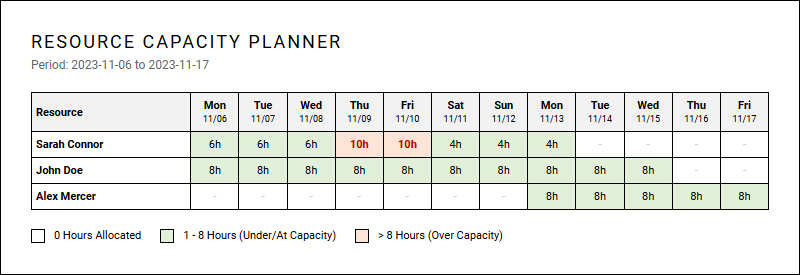
Managing team bandwidth often remains a critical struggle for operations leaders. While standard project funding sources secure your capital, they cannot resolve daily scheduling bottlenecks. This is where our Business & Project Trackers printable calendar grants immediate capacity visibility. Provided that teams first establish clear baseline velocity guidelines, this tool effectively streamlines resource allocation across demanding milestones like Agile sprints. Below, we examine the essential steps to master your capacity planning.
Create Your Resource Allocation and Capacity Planner
Done customizing?
Resource Allocation and Capacity Planner - Good to Know
Resource Utilization
Resource utilization measures the efficiency of an organization's workforce by tracking the percentage of time employees spend on billable projects versus non-billable tasks. Maximizing this metric ensures that valuable human capital is not wasted on administrative overhead or idle periods. To achieve optimal performance, business leaders calculate utilization rates using dedicated resource management software.
- Billable Hours: Time spent directly on revenue-generating client deliverables.
- Non-Billable Hours: Internal training, administrative duties, and business development.
This strategic tracking helps project managers identify underutilized team members who can be immediately reassigned to high-priority initiatives. Maintaining a balanced utilization rate prevents employee burnout while safeguarding the company's profit margins. Regular audits of these metrics allow leadership to make informed decisions regarding talent acquisition, skill development programs, and long-term organizational growth strategies.
Capacity Forecasting
Capacity forecasting is the predictive practice of estimating future resource requirements based on upcoming project pipelines and historical data trends. By analyzing current commitments alongside projected sales, organizations can anticipate talent shortages or surpluses well in advance. This proactive approach enables human resource departments to plan recruitment drives or training initiatives before resource gaps impact project timelines.
- Data Collection: Aggregating historical project metrics and current sales pipeline estimates.
- Gap Analysis: Identifying discrepancies between future workload demand and current workforce supply.
Accurate forecasting mitigates the risk of sudden operational bottlenecks and reduces the necessity for expensive, last-minute hiring. Furthermore, it empowers executives to commit to realistic delivery dates during client negotiations. Integrating predictive analytics tools into the forecasting workflow ensures that estimations remain highly accurate, allowing the business to scale operations smoothly in a fluctuating market environment.
Resource Leveling
Resource leveling is a project management technique used to resolve resource conflicts by adjusting project start and finish dates. This method is applied when shared resources are over-allocated or only available at specific times. When two critical tasks require the same senior developer simultaneously, resource leveling delays one task to prevent overloading that individual.
- Adjusts project schedules based on resource constraints.
- Often extends the overall project duration to protect workforce health.
By extending the project timeline rather than overworking the team, managers maintain high standards of quality and reduce turnover. While this approach can sometimes delay final delivery dates, it guarantees that the work completed is sustainable and error-free. Implementing automated scheduling tools can streamline this process, quickly calculating alternative paths that minimize delays while keeping individual workloads manageable.
FTE Allocation
Full-Time Equivalent (FTE) allocation involves calculating and assigning the equivalent of one full-time employee's productivity across various projects. This metric standardizes resource measurement, especially when managing a mix of full-time, part-time, and contract staff. For instance, two part-time employees working twenty hours a week each equal one FTE.
- Standardization: Simplifies budgeting and resource planning across diverse teams.
- Flexibility: Facilitates fractional allocation across multiple concurrent projects.
Through precise FTE allocation, project management offices can distribute labor costs accurately and avoid overallocation. It provides a clear picture of total human capacity, allowing managers to slice and dice effort without losing track of total availability. Consequently, organizations can optimize their staffing models, ensuring that high-priority projects receive the exact fractional support required to succeed without inflating overhead budgets unnecessarily.
Skill-Based Routing
Skill-based routing is a strategic assignment strategy that matches specific tasks with the most qualified resources based on their unique competencies. Rather than assigning work based solely on availability, this methodology analyzes a detailed inventory of employee skills, certifications, and experience levels. For example, a complex software bug is automatically routed to a senior developer specializing in that specific codebase.
Implementing this system yields several core benefits:
- Improved quality of deliverables due to expert execution.
- Faster turnaround times as experienced personnel handle specialized tasks.
- Enhanced employee satisfaction from working on relevant challenges.
This targeted alignment reduces errors, accelerates project delivery, and enhances overall client satisfaction. It also identifies skill gaps within the current workforce, guiding future training programs. By maintaining an up-to-date skills matrix, organizations can dynamically deploy their best assets to the areas where they will generate the greatest operational impact.
Workload Balancing
Workload balancing is the ongoing process of distributing tasks equitably across a team to prevent individual burnout while maximizing collective productivity. In high-pressure environments, it is common for high performers to be overloaded with work, leading to fatigue and diminished output quality. Workload balancing solves this by continuously monitoring task distributions and reassigning responsibilities as needed.
- Real-time monitoring: Tracking active tasks and stress indicators.
- Collaborative redistribution: Encouraging cross-training to allow team members to assist one another.
By maintaining a fair and manageable distribution of labor, organizations foster a healthier workplace culture and increase overall employee retention. Teams operating under balanced workloads consistently produce higher-quality results and demonstrate greater agility when unexpected project changes arise. Regular check-ins and project management dashboards are essential tools for maintaining this delicate equilibrium.
Bench Management
Bench management refers to the strategic handling of employees who are currently unassigned to active client projects. While having a "bench" provides the flexibility to kick off new projects quickly, an oversized or idle bench represents a significant financial drain. Effective bench management focuses on keeping these underutilized resources engaged and productive.
- Upskilling and Certifications: Encouraging professional development during downtime.
- Internal Projects: Deploying idle staff to internal tool development or research.
- Shadowing: Placing bench employees on active projects to gain hands-on experience.
Proactive bench management transforms potential lost revenue into an opportunity for organizational improvement. By treating bench time as a structured incubation period, businesses ensure that when new client contracts are signed, their idle resources are highly skilled, highly motivated, and ready to deploy instantly.
Resource Smoothing
Resource smoothing is an alternative scheduling technique used when the primary constraint is a fixed project completion date. Unlike resource leveling, which may extend project timelines to resolve resource conflicts, smoothing operates within defined schedule limits. The objective is to minimize fluctuations in resource demand over time without delaying the final delivery.
- Time-constrained: The deadline cannot be shifted under any circumstances.
- Float utilization: Delays non-critical path activities within their free float to optimize resource allocation.
This technique is highly effective for organizations operating under strict contractual deadlines. By smoothing out the peaks and valleys of resource demand, managers can maintain a steady team size and avoid the costly cycle of temporary hiring and sudden layoffs. It requires precise scheduling and a deep understanding of project dependencies to execute successfully.
Capacity Constraint
A capacity constraint occurs when the demand for resources exceeds the maximum available supply, creating an operational bottleneck. These constraints can stem from a shortage of skilled labor, physical equipment limitations, or budgetary boundaries. Identifying these limiting factors is the first step in applying the Theory of Constraints to optimize business workflows.
- Labor constraints: Shortage of specialized developers, engineers, or managers.
- Asset constraints: Limited access to testing environments, servers, or physical hardware.
When a capacity constraint is identified, project managers must prioritize high-value tasks and optimize the bottlenecked resource's schedule. Relieving these constraints through strategic hiring, process automation, or outsourcing is essential for maintaining business growth. Left unaddressed, capacity constraints lead to missed deadlines, poor customer satisfaction, and lost market opportunities.
Demand-to-Capacity Matching
Demand-to-capacity matching is the systematic alignment of incoming client requests and project pipelines with the actual capabilities of the workforce. This synchronization ensures that sales teams do not close deals that the delivery team cannot realistically execute. It serves as a critical bridge connecting business development activities with operational execution.
- Sales and Delivery alignment: Seamless communication between departments.
- Dynamic resource allocation: Adjusting project starts based on real-time availability.
When demand and capacity are perfectly matched, organizations experience smoother project lifecycles, improved profitability, and higher customer satisfaction. This balance prevents the chaotic cycles of over-hiring followed by layoffs, leading to a more stable corporate environment. Businesses that master this alignment can confidently scale operations, secure in the knowledge that every promised deliverable is backed by adequate, capable resources.
Leave a comment