
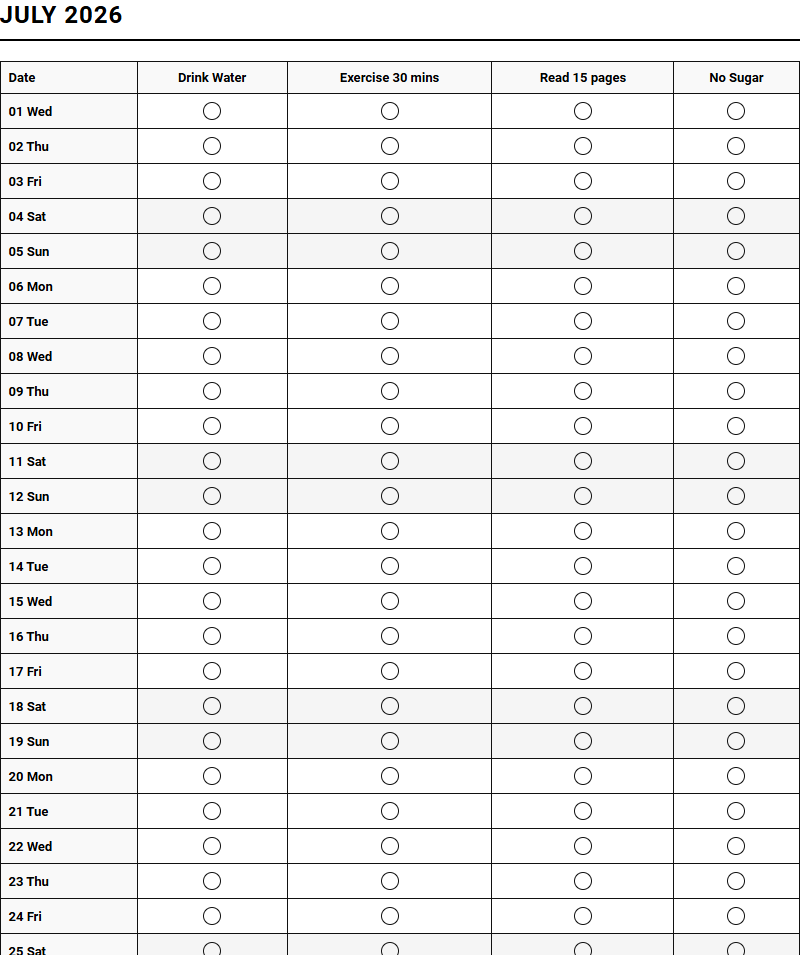
Staying consistent with wellness goals is notoriously difficult, and most people quickly abandon their routines. While many turn to complex digital apps to stay on track, digital fatigue often leads to disengagement. A physical Monthly Habit Calendar bridges this gap, offering immediate visual accountability. To succeed, tracking requires realistic stipulations rather than overwhelming goals. Tracking simple metrics, like daily hydration or 10,000 steps, builds lasting momentum. Below, we detail how to utilize these printable trackers to optimize your daily routine.
Create Your Monthly Habit Calendar
Done customizing?
Monthly Habit Calendar - Good to Know
Habit Stacking
Habit stacking is a highly effective behavioral modification strategy that relies on linking a desired new behavior to an already established daily routine. Created by behavioral scientists and popularized in productivity literature, this method leverages the strong neural pathways your brain has already built for your existing routines. Instead of trying to remember to perform a new action out of thin air, you anchor it to a specific cue that happens automatically every single day.
To implement this technique successfully, you should structure your intentions using a simple, actionable formula:
- The Stack Formula: "After I [Current Habit], I will [New Habit]."
- Example: "After I pour my morning cup of coffee, I will meditate for two minutes."
- Example: "After I close my laptop for the work day, I will immediately do ten push-ups."
By pairing your aspirations with reliable anchors like brushing your teeth, pouring coffee, or checking the mail, you eliminate the cognitive load of deciding when and where to act, transforming erratic efforts into automatic systems.
Micro-habits
Micro-habits are the fundamental building blocks of sustainable personal development, designed to bypass the mental resistance that typically accompanies major lifestyle changes. When we attempt to adopt massive new routines, our brains often rebel due to the sheer effort required. Micro-habits solve this friction by shrinking the desired behavior down to its smallest, most effortless iteration-an action so incredibly simple that it is practically impossible to say no to, even on your worst days.
Consider these transformative scale-downs of common goals:
- Instead of reading a book a week, commit to reading one single page every night.
- Instead of a grueling one-hour workout, commit to performing one minute of stretching.
- Instead of meditating for thirty minutes, focus on taking three deep, conscious breaths.
By focusing entirely on the ritual of showing up rather than the intensity of the performance, you establish a solid foundation of consistency. Once the pathway is carved, expansion happens naturally.
Streak Tracking
Streak tracking is a psychological reinforcement tool that leverages our natural aversion to losing progress. By keeping a continuous record of the days you successfully complete a habit, you build visual momentum that becomes increasingly precious over time. This methodology, famously popularized by comedian Jerry Seinfeld's "don't break the chain" technique, shifts your daily focus from the daunting long-term goal to the immediate, satisfying task of maintaining your current winning streak.
"The chain becomes a physical manifestation of your discipline; the longer it grows, the more motivated you become to protect it from breaking."
Every consecutive day you log your activity, you receive a micro-dose of dopamine that reinforces your behavior. While streaks are incredibly powerful for maintaining momentum during periods of low motivation, it is vital to pair them with a resilient mindset. Implementing a rule like "never miss twice" ensures that an accidental break in your streak remains a temporary hiccup rather than a total collapse of your routine.
Atomic Habits
The concept of atomic habits centers on the compounding power of making tiny, seemingly insignificant adjustments to your daily routine. Just as atoms are the tiny building blocks of complex molecules, atomic habits are the minor practices that build remarkable lifelong results. If you can improve any area of your life by just one percent each day, the mathematical compounding effect dictates that you will end up thirty-seven times better by the end of a single calendar year.
This approach shifts the focus away from setting grand, overwhelming goals and redirects it toward optimizing your underlying daily systems. High-achievers and underachievers often share the exact same goals; it is the superior design of the high-achiever's systems that determines their success. By focusing on tiny, regular iterations, you master the art of continuous self-improvement, allowing small choices to eventually accumulate into revolutionary life transformations.
Habit Loop
To effectively change your behavior, you must first understand the neurological framework that governs every habit you possess, known scientifically as the Habit Loop. Originally identified by researchers at MIT and popularized by Charles Duhigg, this loop consists of a three-part neurological cycle that controls how behaviors become hardwired into our brains over time.
The loop is structured in the following sequence:
- The Cue: A specific trigger that tells your brain to go into automatic mode and which habit to use.
- The Routine: The actual physical, mental, or emotional behavior that you perform in response to the trigger.
- The Reward: The positive feedback or physical satisfaction that helps your brain figure out if this particular loop is worth remembering for the future.
By systematically diagnosing these three elements, you can consciously deconstruct bad habits and replace them with constructive routines while keeping the cues and rewards identical.
Keystone Habits
Keystone habits are unique, highly influential routines that naturally trigger a positive chain reaction throughout your entire life. Just like the keystone in an arch holds all the other stones firmly in place, a keystone habit acts as a structural anchor that makes other positive habits significantly easier to adopt and maintain. When you focus your energy on cultivating just one of these pivotal routines, you initiate a powerful ripple effect that reorganizes your daily priorities without conscious struggle.
Common examples of these transformative habits include:
- Regular Exercise: Frequently leads to better dietary choices, improved sleep quality, and reduced spending.
- Daily Journaling: Often fosters heightened self-awareness, better emotional regulation, and clearer goal-setting.
- Consistent Sleep Patterns: Directly enhances morning focus, emotional stability, and overall willpower reserves.
By identifying and prioritizing these high-leverage activities, you optimize your personal development efforts, achieving maximum lifestyle improvements with highly focused energy.
Behavioral Design
Behavioral design is the practice of consciously organizing your physical and digital environments to make desirable behaviors effortless and undesirable habits highly inconvenient. This discipline is founded on a simple psychological truth: human beings are incredibly prone to following the path of least resistance. Instead of relying purely on willpower, which is a finite and unreliable resource, behavioral design focuses on altering your surroundings to gently nudge your decisions in the right direction.
To implement this, you can focus on two main environment hacks:
- To foster good habits: Decrease friction. Place your gym clothes next to your bed, or keep a fresh water bottle directly on your work desk.
- To eliminate bad habits: Increase friction. Place your television remote in another room, or use website blockers to restrict distracting social media apps during working hours.
When your environment is perfectly aligned with your long-term goals, making the right choice becomes the default option.
Gamified Habit Tracking
Gamified habit tracking transforms the dry, disciplined process of self-improvement into an engaging, interactive adventure by borrowing successful mechanics from video game design. By reframing your real-life tasks as quests and your achievements as experience points, this methodology taps into our innate desire for play, competition, and progression. It turns daily discipline into an active game where you can watch your character-representing your real self-grow stronger with every positive action.
Key gamification elements that drive engagement include:
- Leveling Up: Earning experience points (XP) for completing daily tasks and unlocking new personal milestones.
- In-Game Rewards: Earning virtual currency to spend on real-life rewards, like watching a movie or enjoying a favorite treat.
- Social Quests: Joining guilds with friends to hold each other accountable through shared challenges and boss battles.
This playful framing reduces boredom, turning routine maintenance into an ongoing, rewarding journey of personal growth.
Identity-Based Habits
The most profound and lasting way to change any behavior is to shift your focus away from what you want to achieve and focus entirely on who you wish to become. This concept, known as identity-based habits, argues that true behavior change is actually identity change. Most people start the habit-building process by focusing on outcomes, such as losing weight or writing a book, which often leads to temporary changes. When you shift your core beliefs about yourself, your actions naturally align with that new self-image.
To build an identity-based system, follow these two steps:
- Decide the exact type of person you want to be (e.g., a healthy person, a reliable writer, or a mindful leader).
- Prove this identity to yourself every single day with small, consistent, and undeniable victories.
Every action you take is a vote for the type of person you wish to become, securing long-term change from the inside out.
Visual Progress Tracking
Visual progress tracking is a highly effective way to make your daily achievements tangible, satisfying, and immediately clear to your brain. Human beings are deeply visual creatures, and our motivation levels drop significantly when we feel like our daily efforts are not producing visible, real-world results. By translating your abstract daily efforts into clear, colorful visual cues, you create a direct, motivating feedback loop that constantly validates your discipline and hard work.
Effective visual tracking systems include:
- The Jar Method: Moving paperclips or marbles from one clear jar to another for every completed task.
- Wall Calendars: Crossing off days with a bold red marker to build a highly visible, continuous chain of success.
- Digital Dashboards: Utilizing color-coded charts and progression bars that dynamically fill up as you complete tasks.
These tactile and visual displays provide immediate satisfaction, keeping your motivation burning bright during the long plateaus of your development journey.
Leave a comment