
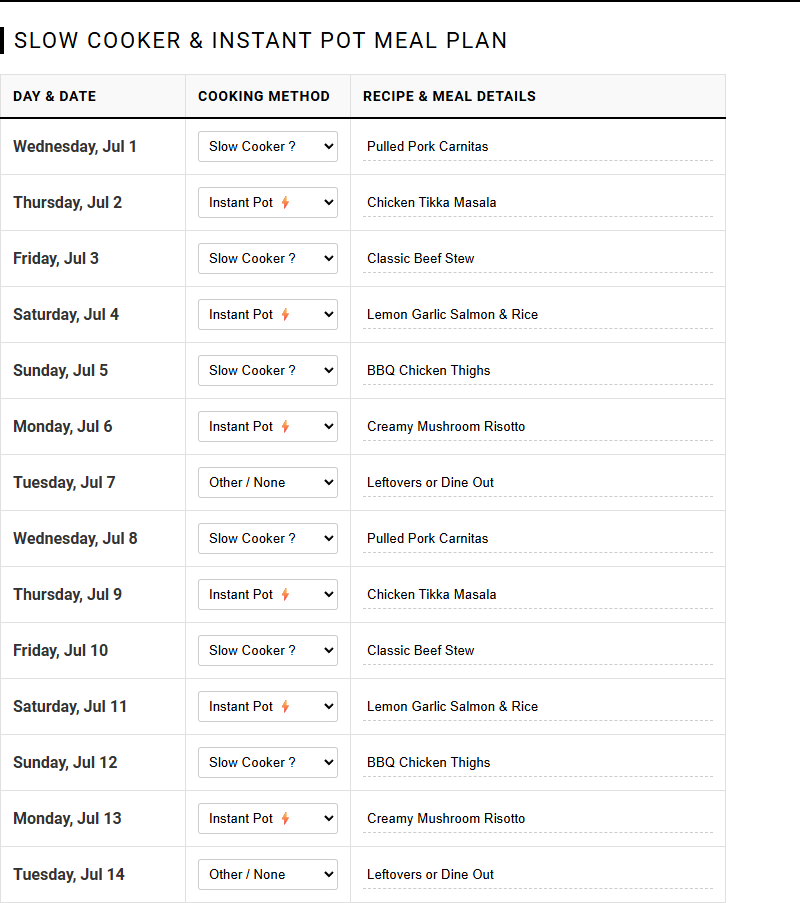
Managing nightly family dinner prep often leads to chaotic evenings and decision fatigue. While traditional cookbooks and standard grocery budgets help, they rarely streamline daily execution. Our printable Slow Cooker and Instant Pot Meal Calendar grants you immediate kitchen organization and peace of mind. Under the stipulation that you utilize basic countertop appliances, proven recipes like Honey Garlic Chicken become effortless. Below, we break down how this monthly planning system will transform your dinner routine.
Create Your Slow Cooker and Instant Pot Meal Calendar
Done customizing?
Slow Cooker and Instant Pot Meal Calendar - Good to Know
Dump-and-go weekly schedule
Streamlining your kitchen routine begins with a structured dump-and-go weekly schedule. This meal prep method eliminates active cooking time by utilizing raw ingredients prepped in advance, stored in containers, and emptied directly into your appliance. By dedicating just one hour on Sunday to chopping vegetables and portioning proteins, you establish a seamless pipeline for the upcoming week.
To maximize efficiency, categorize your weekly menu by protein types and flavor profiles. Consider this optimal weekly layout:
- Monday: Hearty chicken fajita bowls with sliced bell peppers and onions.
- Wednesday: Vegetarian lentil dahl infused with coconut milk and aromatic spices.
- Friday: Slow-simmered beef chili featuring kidney beans and crushed tomatoes.
By organizing your ingredients into designated silicone bags, you eliminate mid-week decision fatigue. This systematic approach ensures fresh, home-cooked dinners require nothing more than opening a container and pressing a start button.
Crockpot freezer meal rotation
An organized crockpot freezer meal rotation is the ultimate defense against busy weeknights and chaotic schedules. This technique involves assembling raw ingredients directly into heavy-duty freezer bags, freezing them flat, and thawing them overnight before slow cooking. Because the ingredients cook together from a raw state, the flavors meld deeply, resulting in superior taste and texture.
To maintain a diverse and successful rotation, follow these structured steps:
- Label every freezer bag with the recipe name, date prepared, and specific cooking instructions.
- Group meals by cooking times to ensure you always have options for both short and long days.
- Keep an active inventory on your refrigerator door to track what needs to be consumed.
This system prevents food waste and drastically reduces grocery bills by allowing you to buy ingredients in bulk. Your freezer becomes a curated marketplace of effortless, nourishing dinners.
Dual-device batch cooking
Maximize your kitchen efficiency by mastering the art of dual-device batch cooking. By pairing a high-pressure cooker with a traditional slow cooker, you can prepare an entire week of diverse meals in a single afternoon. This approach allows you to exploit the unique strengths of both appliances simultaneously: pressure cooking for tough meats and grains, and slow cooking for gentle simmering.
For example, while your pressure cooker rapidly prepares a massive batch of shredded chicken breast or brown rice, your slow cooker can gently braise a rich beef stew or caramelize onions. Utilizing this dual-appliance strategy slashes your active meal prep time in half.
This method prevents flavor fatigue, as you can easily create contrasting textures and cuisines at the same time. Investing in this coordinated workflow yields high-volume, nutrient-dense meal components with minimal supervision.
Pot-in-pot meal planning
The pot-in-pot (PIP) cooking method is a revolutionary technique that allows you to cook multiple components of a meal separately but simultaneously within a single pressure cooker chamber. By utilizing elevated steam racks and heatproof containers, you can cook your main protein on the bottom while steaming delicate grains or vegetables in an elevated bowl above it.
"Pot-in-pot cooking preserves the distinct flavors and textures of individual ingredients, preventing them from turning into a homogenous mush."
This technique is perfect for dishes like teriyaki chicken with jasmine rice, or meatloaf with mashed potatoes. To succeed, ensure your elevated vessel is made of food-grade stainless steel or tempered glass, and always add the required minimum amount of liquid to the bottom of the main inner pot to generate sufficient steam pressure.
Slow-to-pressure conversion guide
Transitioning traditional slow cooker recipes for a modern pressure cooker requires a clear understanding of heat transfer and moisture retention. Because pressure cookers rely on a sealed environment, very little liquid evaporates during the cooking process. Consequently, you must adjust both liquid volumes and cooking times to achieve optimal results.
Refer to this quick reference guide for common recipe conversions:
| Slow Cooker (Low / High) | Pressure Cooker (High Pressure) | Liquid Adjustment |
|---|---|---|
| 8 Hours Low / 4 Hours High | 25 to 30 Minutes | Reduce liquid by 30-50% |
| 6 Hours Low / 3 Hours High | 15 to 20 Minutes | Reduce liquid by 25% |
Always ensure you have at least one cup of thin, water-based liquid to safely build pressure and avoid the dreaded burn warning.
Set-and-forget dinner calendar
Establishing a set-and-forget dinner calendar removes the daily cognitive load of answering the question: "What is for dinner?" By mapping out your monthly meals around automated cooking appliances, you synchronize your grocery shopping with your personal schedule. This calendar categorizes days based on your anticipated availability and energy levels.
For instance, schedule your longest-cooking crockpot meals on your busiest office days, ensuring you walk through the door to a fully cooked, aromatic dinner. On lighter days, schedule quick-cycling pressure cooker meals. This proactive organization minimizes the temptation of ordering takeout and stabilizes your household budget. Your appliances do the heavy lifting while you focus on your career, family, and personal wellness goals throughout the busy workweek.
One-pot seasonal meal prep
Aligning your nutrition with nature is simple when practicing one-pot seasonal meal prep. Utilizing a multi-cooker allows you to highlight fresh, local ingredients at their peak nutritional value while minimizing cleanup. Each season offers a unique palette of flavors that adapt beautifully to one-pot cooking methods.
In the autumn and winter, focus on dense root vegetables, squashes, and robust brassicas simmered with bone broths and warming spices. As spring and summer arrive, transition to lighter broths featuring sweet peas, asparagus, and fresh herbs added at the very end of the cooking cycle to preserve their vibrant color. By cooking seasonally, you enjoy superior taste, support local agriculture, and naturally diversify your micronutrient intake throughout the changing year.
Five-ingredient multi-cooker plan
Simplicity is key to sustainable healthy eating, and the five-ingredient multi-cooker plan proves you do not need a complex pantry to create delicious meals. By focusing on high-impact ingredients, you reduce preparation time, minimize grocery expenses, and lower cooking stress. The secret lies in selecting ingredients that carry concentrated flavor profiles.
Consider this minimalist ingredient framework for your next prep session:
- Protein: Chicken thighs or firm tofu blocks.
- Aromatics: Jarred salsa salsa verde or minced garlic.
- Base liquid: Low-sodium vegetable or chicken bone broth.
- Vegetable: Frozen stir-fry blend or sweet potato cubes.
- Flavor enhancer: Smoked paprika, curry paste, or taco seasoning.
Combining these five targeted components yields a complex, satisfying dish with virtually no tedious prep work required.
Warm-and-serve daily tracker
Maintaining food safety and peak flavor is effortless when implementing a warm-and-serve daily tracker. When managing batch-cooked meals, tracking reheating schedules and storage times prevents food spoilage and preserves texture. This system utilizes a simple log to monitor your refrigerated and frozen inventory.
Always reheat your prepped meals to an internal temperature of 165°F before serving. If your multi-cooker features a automated "keep warm" function, limit its use to a maximum of two to four hours to prevent your food from drying out or entering the bacterial danger zone. By tracking when meals were cooked, when they were frozen, and how they should be reheated, you guarantee that every warm-and-serve meal is as safe, nutritious, and delicious as the day it was made.
Macro-friendly pressure cooker planner
Achieving your fitness goals is significantly easier with a macro-friendly pressure cooker planner. High-pressure cooking is uniquely suited for preparing lean proteins like chicken breast, turkey breast, and pork tenderloin without drying them out. Because pressure seals in moisture, lean meats remain tender and highly palatable throughout the week.
Use your planner to organize meals by macronutrient targets, dedicating specific cooking days to batch-prepping lean proteins, complex carbohydrates, and fiber-rich vegetables. For example, pressure cook a large batch of seasoned shredded beef for your protein base, alongside a separate batch of quinoa or wild rice. Having these high-quality, pre-measured components readily available in your refrigerator ensures you consistently hit your daily protein, carbohydrate, and fat targets with absolute precision.
Leave a comment