
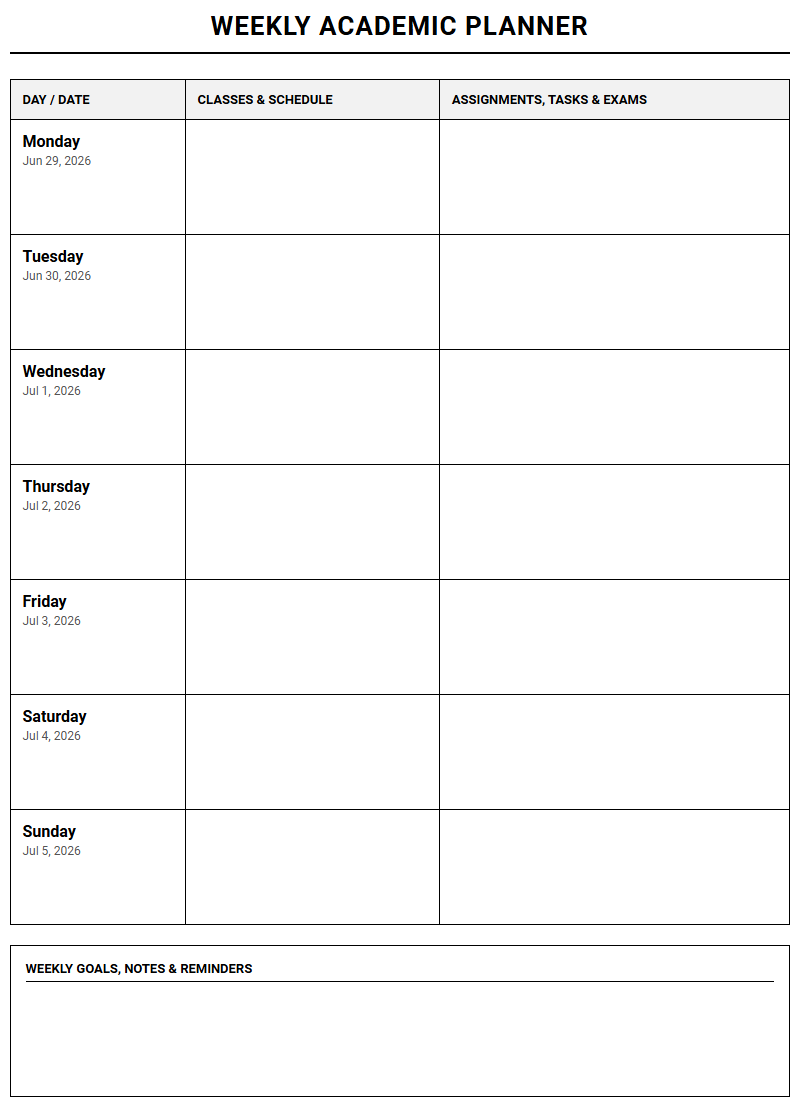
Juggling tight academic deadlines and lectures often leads to overwhelming cognitive overload for students. While standard digital alerts offer baseline scheduling support, they frequently fail to provide a cohesive visual workflow. Our printable Academic and Student Weekly Planner grants immediate spatial clarity, provided that users commit to daily manual entry. Featuring dedicated sections for exam prep and project milestones, this guide outlines how to leverage these physical templates to optimize your semester.
Create Your Academic and Student Weekly Planner
Done customizing?
Academic and Student Weekly Planner - Good to Know
Syllabus tracker
A comprehensive syllabus tracker serves as the foundation of academic organization, transforming overwhelming course documents into actionable roadmaps. By breaking down each course into modular topics, students can systematically monitor their progress throughout the semester. This systematic approach ensures that no reading assignment, lecture topic, or minor quiz slips through the cracks.
Using a structured digital table helps visualize the layout of your academic requirements:
| Course Module | Resource Link | Status | Confidence Level |
|---|---|---|---|
| Introduction to Organic Chemistry | Chapter 1 Slides | Completed | High |
| Stereochemistry Foundations | Chapter 2 Notes | In Progress | Medium |
By mapping out curriculum milestones early, you establish a clear visual connection between daily study tasks and broader learning objectives, paving the way for consistent academic performance.
Spaced repetition schedule
The spaced repetition schedule leverages the psychological spacing effect to maximize long-term memory retention while minimizing study time. Instead of cramming information inefficiently, students review concepts at increasing intervals, disrupting the forgetting curve before knowledge fades. This technique proves highly effective for vocabulary, complex formulas, and core conceptual frameworks.
Implementing an organized review schedule involves tracking specific intervals:
- Immediate Review: Triggered within 24 hours of first exposure.
- First Boundary: Scheduled 3 days later to reinforce neural pathways.
- Second Boundary: Positioned at 7 days to solidify conceptual recall.
- Maturity Review: Conducted 14 to 30 days later for deep permanent storage.
By strictly adhering to these calculated review windows, learners shift critical facts from temporary working memory into stable, easily accessible long-term storage, optimizing overall study efficiency.
Assignment deadline tracker
Managing multiple overlapping assignments requires a centralized assignment deadline tracker designed to eliminate last-minute panic. Rather than relying on memory or scattered emails, documenting deadlines chronologically allows you to prioritize high-value tasks and allocate preparation time logically. Visualizing workload peaks prevents burnout during midterms and finals weeks.
An optimized deadline registry utilizes precise metadata for every deliverable:
- Identify the assignment name, weight percentage, and strict submission deadline.
- Deconstruct the final goal into smaller, manageable micro-deadlines.
- Update status markers such as Not Started, Drafting, or Under Review.
Maintaining this level of detail offers a clear path forward, keeping you accountable and ensuring every paper, lab report, and project is completed and submitted well ahead of the final bell.
Time blocking
Time blocking is a highly productive time-management methodology that encourages you to partition your day into distinct, dedicated blocks of time. Each block is strictly reserved for a specific task or group of tasks, which prevents the cognitive drain of constant multitasking. By treating these blocks as non-negotiable appointments, you protect your focus from daily distractions.
A typical structured study day might follow this organized layout:
- 09:00 AM - 10:30 AM: Deep Focus Block (Writing research paper draft)
- 10:45 AM - 12:00 PM: Active Review Block (Solving complex calculus problems)
- 01:30 PM - 02:30 PM: Administrative Block (Answering emails, sorting digital files)
Dedicating structured time slots to singular pursuits allows you to enter a flow state more rapidly, significantly increasing both the quality and quantity of your daily output.
GPA tracker
An active GPA tracker acts as a financial ledger for your academic career, providing real-time insight into your cumulative standing. By inputting individual assignment scores and factoring in course credit weights, you can estimate your final grades long before the semester ends. This mathematical clarity removes anxiety and helps focus your energy where it is needed most.
To monitor your progress accurately, maintain a record of weight distributions:
| Assessment Type | Syllabus Weight | Target Score | Current Earned Score |
|---|---|---|---|
| Midterm Exams | 30% | 90% or higher | 92% |
| Final Research Project | 40% | 95% or higher | Pending |
Regularly updating these figures helps you adjust your study efforts dynamically, ensuring your academic goals remain realistic, measurable, and highly attainable.
Pomodoro study log
The Pomodoro study log is an excellent tool for tracking focused study intervals while preventing mental fatigue. By working in traditional 25-minute sessions separated by 5-minute restorative breaks, you maintain high levels of cognitive performance throughout the day. Logging these sessions provides tangible proof of your daily dedication and work ethic.
Tracking your daily cycles helps identify patterns in your personal productivity:
- Morning Sessions: 4 Pomodoros completed (focused on analytical problem-solving).
- Afternoon Sessions: 3 Pomodoros completed (focused on reading and annotation).
- Total Daily Focus Time: 175 minutes of high-intensity cognitive work.
Analyzing your completed cycles over time helps you spot peak energy hours, allowing you to schedule your most challenging academic tasks during periods of natural, high-level focus.
Semester overview
A comprehensive semester overview functions as a high-level roadmap, offering a bird's-eye view of your entire academic term. This macro-level perspective consolidates major events, university holidays, exam blocks, and critical project deadlines onto a single timeline. Having this broad view helps prevent unexpected surprises and supports balanced life planning.
Key milestones to include in your macro calendar view include:
- Official course add/drop registration deadlines.
- Midterm examination windows and scheduled study days.
- Major assignment draft submissions and peer review dates.
- Final examination week schedules and winter or summer break commencements.
This big-picture alignment helps you balance academic demands with personal commitments, work shifts, and necessary downtime, fostering a healthier and more sustainable student lifestyle.
Active recall tracker
The active recall tracker is designed to replace passive review habits, such as highlighting or re-reading, with high-impact self-testing. This method forces your brain to retrieve information actively, strengthening memory connections and identifying gaps in your understanding. Tracking your performance across retrieval attempts highlights exactly what needs your attention.
Consider structuring your active recall logs with a straightforward color-coded feedback system:
- Red Status: Poor retrieval; struggle to remember basic terms (requires review tomorrow).
- Yellow Status: Partial retrieval; recalled core ideas but missed key details (review in 3 days).
- Green Status: Flawless retrieval; explained the concept clearly (review in 7 days).
Actively testing your understanding ensures that your study sessions are spent mastering challenging material, rather than wasting time reviewing concepts you have already memorized.
Exam prep checklist
An exam prep checklist transforms pre-exam anxiety into structured preparation by breaking down vast study materials into clear, actionable steps. Instead of wondering where to begin your review, you can follow a logical sequence of tasks designed to ensure total mastery of the material. This method ensures all lectures, practice tests, and readings are thoroughly covered.
An effective preparation strategy should include these key steps:
- Gather all lecture slides, personal notes, and textbook chapters.
- Complete a minimum of two timed practice exams under realistic conditions.
- Attend professor office hours to clarify lingering questions on difficult topics.
- Summarize complex theories into single-page quick-reference sheets.
Systematically checking off these preparation tasks builds confidence, ensuring you enter the examination room fully prepared and mentally ready to perform at your absolute best.
Study session planner
A intentional study session planner prevents aimless studying by establishing clear goals before you open a book or laptop. Setting specific, measurable objectives for each session keeps you focused and prevents procrastination. Knowing exactly what you want to accomplish ensures that every minute of study time is used effectively.
A well-structured session plan should cover these essential elements:
- Primary Objective: Learn and write out the biological steps of cellular respiration.
- Required Materials: Biology textbook, notebook, drawing tablet, and colored pens.
- Time Limit: 90 minutes of focused effort followed by a self-assessment quiz.
Approaching every study block with a clear plan of action helps you work efficiently, turning routine study hours into productive sessions of deep, meaningful learning.
Leave a comment