
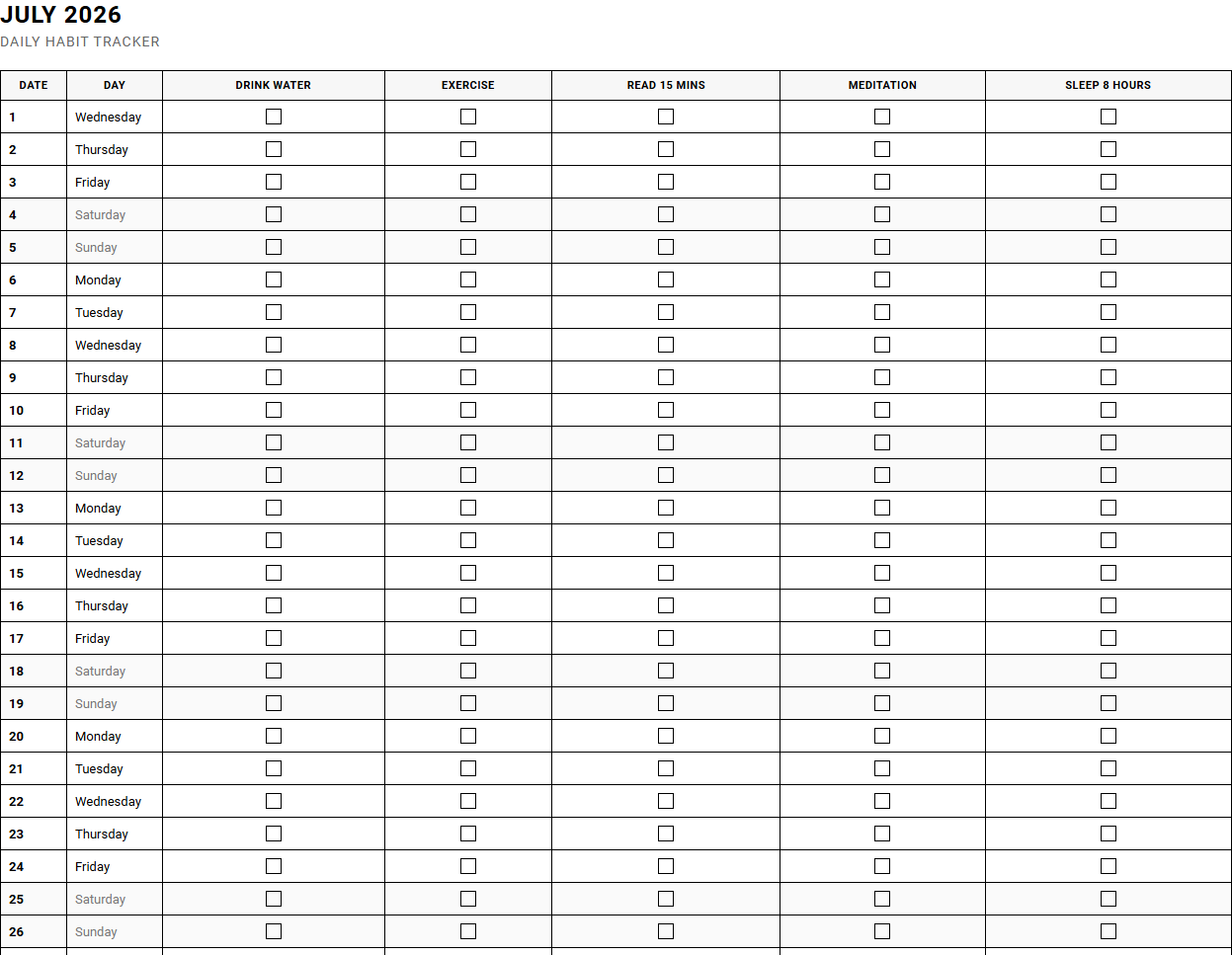
Struggling to maintain consistency with new routines is a universal hurdle. While digital apps offer reminders, they often contribute to screen fatigue. Our printable Daily Habit Tracker Agenda bridges this gap, granting immediate, tactile accountability that reinforces retention. Note that while this framework structures your day, sustainable success still requires active, intentional engagement. By physically logging milestones-such as daily hydration tracking-you build a visual success loop. Below, we outline how to maximize this printable tool to systematically upgrade your daily routine.
Create Your Daily Habit Tracker Agenda
Done customizing?
Daily Habit Tracker Agenda - Good to Know
Habit stacking
Habit stacking is a highly effective behavioral strategy that leverages your current daily patterns to build new, sustainable behaviors. Instead of trying to insert a new habit into a random part of your day, you anchor it directly to an established, automatic trigger. This technique utilizes the cognitive pathways your brain has already developed through years of repetition.
To implement this method successfully, you can utilize a simple, structured formula:
- The Formula: After [Current Habit], I will [New Habit].
- Morning Example: After I pour my morning cup of coffee, I will meditate for two minutes.
- Evening Example: After I close my laptop for the workday, I will immediately do ten push-ups.
By piggybacking on existing neural networks, you eliminate the cognitive load of deciding when and where to act, transforming intention into automatic execution.
Micro-habits
Micro-habits operate on the philosophy of radical simplification, urging you to shrink a desired behavior down to its smallest, most effortless iteration. When a task requires minimal willpower, the barrier to entry vanishes, making action inevitable even on days when your energy and motivation are completely depleted.
Consider the contrast between ambitious goals and their micro-habit equivalents:
- Instead of aiming to read one book per week, commit to reading just one single page every night.
- Instead of planning a one-hour gym workout, commit to doing one single minute of stretching.
- Instead of attempting to floss all your teeth, commit to flossing just one tooth.
The core objective is to master the art of showing up. Once the small baseline behavior is established as a consistent daily ritual, the momentum naturally drives you to exceed the initial micro-goal.
Time blocking
Time blocking is a cognitive management method where you divide your day into distinct, dedicated blocks of time. Unlike a standard, open-ended to-do list, this practice forces you to respect the physical constraints of a twenty-four-hour day by assigning specific tasks to concrete time slots.
"By dedicating a specific window of time to a single activity, you protect your focus from the constant distraction of multitasking and decision fatigue."
During these dedicated blocks, you commit to working exclusively on the designated task while ignoring all other demands. This deep-work approach creates a structured container for your attention, allowing you to enter flow states much faster. It transforms vague intentions into a highly organized, visual map of your productivity throughout the day.
Streak tracking
Streak tracking capitalizes on the human desire for visual progress and continuity, famously popularized by the "don't break the chain" productivity method. By visually recording each consecutive day you successfully perform a habit, you build a tangible representation of your growing commitment and momentum.
Using physical calendars, habit tracking apps, or bullet journals provides immediate feedback that satisfies your brain's reward center. To keep this strategy highly effective, implement these practical rules:
- Never miss two days in a row; a single slip is an accident, but a second slip is the start of a new, bad habit.
- Keep the tracking tool highly visible in your physical environment.
- Celebrate milestone streaks, such as reaching 10, 30, or 100 consecutive days of execution.
The visual pain of breaking a long, beautiful streak often becomes a powerful motivator to execute your habit on difficult days.
Identity-based habits
Identity-based habits shift your focus from what you want to achieve to who you wish to become. True, lasting behavior change does not stem from outcome-oriented goals, but rather from a fundamental shift in your self-image. When a behavior becomes an integral part of your identity, you no longer need to force yourself to do it.
This psychological transformation occurs through a simple, repetitive loop:
First, decide the type of person you want to be. Second, prove it to yourself with small, daily wins. For example, every time you write a single page, you are acting as a writer. Every time you choose a healthy meal, you are acting as a healthy person. These small actions function as votes for your new identity, gradually reshaping how you perceive yourself and your capabilities.
Bullet journal
The Bullet Journal is an analog organization system designed by Ryder Carroll that serves as a mindful planning tool and habit log. By utilizing a simple system of rapid logging with bullets, dashes, and signifiers, you can track your past, organize your present, and plan your future in a single notebook.
This versatile paper-based framework relies on several core components:
- The Daily Log: For rapid, real-time capture of thoughts, tasks, and events.
- The Monthly Log: For a broad, birds-eye view of your ongoing commitments and time.
- Custom Trackers: Tailored grids designed to monitor specific daily behaviors and wellness metrics.
The tactile act of manually writing down your progress fosters a deeper sense of self-reflection, mindfulness, and intentionality that digital applications simply cannot replicate.
Gamified productivity
Gamified productivity infuses the engaging mechanics of game design into your everyday routines, turning mundane tasks into interactive quests. By introducing elements like experience points (XP), levels, rewards, and avatar progression, you tap into your brain's natural dopamine pathways to make achievement feel inherently fun.
To successfully gamify your life, consider building a structure that mimics popular games:
- Assign difficulty ratings to tasks, rewarding yourself with XP upon completion.
- Create customized rewards, such as unlocking an episode of a favorite show after earning enough points.
- Join online communities to complete collaborative quests with accountability partners.
This playful framing reduces the friction of starting difficult chores, transforming overwhelming workloads into engaging challenges that you actively look forward to conquering.
Keystone habits
Keystone habits are crucial routines that trigger a positive chain reaction throughout your entire life. These foundational behaviors do not merely improve one isolated area; instead, they naturally encourage the development of other beneficial habits, slowly restructuring your daily routines without conscious effort.
For instance, establishing a regular exercise routine often leads to spontaneous improvements in nutrition, sleep quality, stress management, and workplace productivity. Similarly, daily family dinners or keeping a food journal can spark unexpected positive shifts in financial discipline and emotional well-being. By identifying and focusing your limited energy on these high-leverage keystone habits, you create a powerful ripple effect that elevates your overall quality of life.
Habit loop
The habit loop is the neurological framework that governs every automated behavior you perform. Made popular by Charles Duhigg, this loop consists of three distinct, recurring phases that occur in rapid succession within your basal ganglia:
First comes the cue, a trigger that tells your brain to go into automatic mode. Second is the routine, which is the physical, mental, or emotional behavior you perform. Third is the reward, a positive stimulus that helps your brain determine if this particular loop is worth remembering for the future.
- Identify the Cue: Locate the specific trigger, such as a time of day or emotional state.
- Examine the Reward: Understand the underlying craving your routine is trying to satisfy.
- Insert a New Routine: Swap out the negative behavior for a positive one while keeping the cue and reward identical.
Understanding this cycle allows you to deconstruct and redesign any behavior.
Routine building
Routine building is the deliberate process of organizing individual habits into a cohesive, structured sequence that flows naturally throughout your day. While isolated habits are valuable, a well-designed routine weaves these habits together, drastically reducing the mental energy required to transition from one task to the next.
Effective routine building relies on clustering activities by energy levels and contexts:
- Morning Routines: Focus on proactive behaviors like hydration, movement, and deep focus to set a positive tone.
- Shutdown Routines: Focus on organizing outstanding tasks to clear your mind for relaxation.
- Evening Routines: Focus on restorative practices like reading and dimming lights to prepare your body for deep sleep.
A structured daily routine acts as a protective shield for your focus, keeping you aligned with your long-term goals.
Leave a comment