
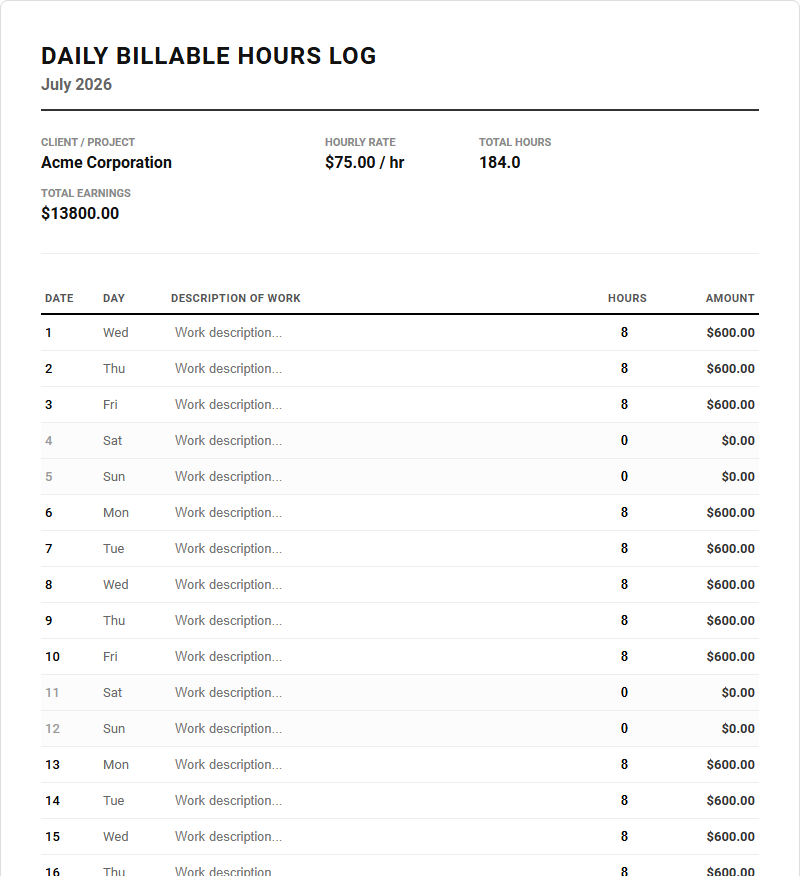
Freelancers frequently struggle to track every billable hour, leaking revenue to administrative errors. While securing capital through standard funding sources drives growth, maximizing daily cash flow is vital. Utilizing a structured framework grants you immediate clarity, under the stipulation of consistent, daily tracking. Physical tools like the Daily Agendas printable calendar offer a proven solution for this challenge. Below, we outline how to implement a Freelancer Daily Billable Hours Log to optimize your productivity and billing.
Create Your Freelancer Daily Billable Hours Log
| Date | Day | Description of Work | Hours | Amount |
|---|
Done customizing?
Freelancer Daily Billable Hours Log - Good to Know
Timesheet automation
Transitioning from manual data entry to timesheet automation represents a pivotal shift in organizational productivity. Modern businesses utilize automated tracking systems to capture employee hours seamlessly, removing human error and reducing administrative overhead. This technology dynamically logs activities in the background, allowing creative and technical teams to focus purely on high-value output.
Implementing an automated timesheet system provides several operational advantages:
- Reduced errors: Minimizes the risk of forgotten or estimated hours.
- Time savings: Saves employees hours previously spent on manual weekly submissions.
- Instant approvals: Managers receive structured summaries that speed up verification cycles.
By capturing precise data, organizations establish a reliable foundation for auditing, performance evaluation, and payroll processing, transforming a historical chore into a strategic asset.
Billable utilization rate
The billable utilization rate is a vital metric that measures the percentage of available working hours spent on revenue-generating tasks. Maintaining a healthy ratio directly correlates with professional services profitability and resource efficiency. Agencies must balance client-facing delivery with necessary internal development to prevent employee burnout.
To calculate this metric, organizations divide total billable hours by the total capacity of the workforce. Consider this structured hierarchy of factors that influence utilization:
- Resource allocation: Matching the right skillset with the correct client demands.
- Scope management: Ensuring project scopes do not expand without formal adjustments.
- Administrative load: Reducing mandatory non-billable meetings for billable consultants.
Consistently monitoring this rate allows project managers to forecast recruitment needs, optimize pricing structures, and identify bottlenecks in service delivery workflows.
Time leakage
Unrecorded work represents a silent threat to profitability, commonly known as time leakage. This phenomenon occurs when minor client interactions, such as brief emails, phone calls, or quick revisions, go completely unlogged. Over time, these brief intervals compound into significant financial losses for professional service providers.
"Even ten minutes of undocumented work per employee daily translates to thousands of dollars in lost annual revenue."
Organizations combat leakage by deploying intuitive tracking tools that make logging small micro-tasks frictionless. Cultivating a cultural habit of recording all efforts ensures that client work is accounted for accurately. Addressing leakage ensures that businesses are compensated for the genuine depth of their intellectual labor and client dedication.
Retainer tracking
Managing ongoing services requires robust retainer tracking to maintain trust and protect margins. When clients pay a fixed fee upfront for a set amount of monthly work, precise monitoring prevents scope creep and under-delivery. It is essential to ensure that the actual hours worked align cleanly with the prepaid budget.
Efficient tracking ecosystems typically categorize retainer utilization using structured categories:
Allocated Hours: The total time pool purchased by the client.Consumed Hours: The real-time tally of completed work.Burn Rate: The velocity at which the retainer is exhausted during the month.
By checking these metrics regularly, account managers can proactively renegotiate terms or adjust resources before crossing critical budget thresholds.
Time blocking log
A structured time blocking log encourages deep focus by dividing the workday into distinct, dedicated time slots. Rather than reacting to notifications as they arrive, professionals designate specific blocks for writing, programming, meetings, or research. This intentional scheduling reduces context-switching costs and enhances overall cognitive performance.
- Deep Work Blocks
- Uninterrupted intervals focused on complex, creative, or analytical tasks.
- Shallow Work Blocks
- Dedicated segments for processing administrative chores, emails, and routine updates.
Maintaining a detailed log of these planned blocks versus actual execution allows workers to refine their estimation skills. This practice creates a transparent record of daily priorities and helps individuals regain mastery over their professional schedules.
Fractional billing
For specialized consultants, fractional billing ensures that brief but highly valuable interventions are billed accurately. Traditional hourly billing often fails to capture the value of quick, high-impact expert consultations. By utilizing increments like tenths of an hour or fifteen-minute blocks, billing remains equitable for both parties.
| Billing Increment | Hour Fraction | Application Case |
|---|---|---|
| 6 Minutes | 0.10 | Quick email responses or rapid diagnostic reviews |
| 15 Minutes | 0.25 | Brief check-ins and standard status updates |
This granular approach protects service providers from donating free advisory sessions while offering clients transparent, itemized invoices that clearly reflect exact consumption patterns.
Non-billable hours tracking
While billable work generates immediate cash flow, non-billable hours tracking is crucial for evaluating long-term operational health. Activities such as business development, internal training, research, and infrastructure maintenance represent investments in the firm's future capacity. Neglecting to track these hours obscures the true cost of running a business.
A comprehensive analysis of non-billable time helps leadership identify administrative inefficiencies. For example, excessive internal meetings might suggest a need for streamlined communication policies. By categorizing and measuring non-billable activities, firms can allocate internal budgets wisely, optimize overhead costs, and maintain a sustainable balance between administrative needs and commercial execution.
Client-specific project codes
Organization is key to managing diverse portfolios, and client-specific project codes provide the taxonomy required for clarity. Using standardized alphanumeric codes allows databases to instantly filter, aggregate, and analyze financial data across departments. This systemic structure prevents logging errors and ensures that metrics map to the correct accounts.
A standardized naming convention often follows this hierarchical format:
CLIENT-ID: A unique identifier for the parent organization.PROJ-TYPE: Code indicating whether the work is development, design, or consulting.YEAR-PHASE: Temporal marker to track seasonal or phase-specific tasks.
Adopting this rigorous system streamlines onboarding, simplifies data integration, and allows finance teams to run complex profitability reports with confidence.
Real-time activity tracker
A real-time activity tracker captures work as it happens, eliminating the reliance on end-of-week memory recall. Operating silently on desktop or web interfaces, these tools record applications used, documents edited, or browser tabs visited. This provides a highly accurate, objective view of how the workday unfolds.
Key features of professional-grade real-time tracking systems include:
- Smart Categorization: Automatically tags activities based on keywords or active window titles.
- Idle Detection: Pauses tracking when the user steps away, ensuring data accuracy.
- Privacy Controls: Allows users to toggle tracking off during personal breaks.
Integrating these systems provides micro-level insights that empower employees to manage their energy better and eliminate productivity bottlenecks.
Invoice integration
Connecting time logs directly to payment pipelines via invoice integration is the final step in a modern billing cycle. When time-tracking software syncs with accounting platforms, invoices are generated automatically from approved timesheets. This automation minimizes billing disputes and dramatically accelerates payment cycles.
"Seamless invoice systems bridge the gap between completed work and realized revenue."
This digital bridge reduces friction by itemizing tasks, displaying project codes, and applying client-specific rates automatically. By eliminating the manual transfer of timesheet data into billing templates, agencies reduce the risk of clerical errors, presenting a highly professional, accurate billing experience to their clients.

Leave a comment